


When gas seepages are reported, the first questions for national authorities are simple but consequential: what is the source(s) of the gas, do they signal a working petroleum system worth exploring, or do they represent shallow, near-surface gas? To find out, the national petroleum authority sampled a dozen previously-reported seeps and procured APT to run the analyses, interpret the data and provide recommendations.
Using gas composition and stable-isotope geochemistry, APT fingerprinted each seep – establishing the gas character and flagging similarities and differences and what that could mean. Seeps were also ranked to identify potential economic resource in the subsurface and guide future evaluation programs.
Scope Of Work
Gas seepages had been reported at sites across the province. The national authority set out to establish whether they indicated a working petroleum system, and procured APT to analyse and evaluate the data.
- Field sampling of a dozen previously-reported seep sites was carried out using Gas Tubes.
- Hydrocarbon gas composition (C1–C6+) and non-hydrocarbon gases (CO2, N2, O2+Ar) were analyzed.
- Stable-isotope profiling – δ13C, δD & δ15N of the gas components with sufficient concentration.
- Interpretation of gas source (biogenic / thermogenic) and thermal maturity using standard genetic and maturity cross-plots.
- Characterisation of gas composition – hydrocarbon vs non-hydrocarbon content – to flag disconnects and rank resource potential.
“Seeps are a tremendously valuable source of data into the subsurface. By fingerprinting gas seeps – their composition and isotopes – we can separate shallow biogenic from thermogenic gas leaking out of potential petroleum systems, and guide regulators, NOC’s and operator as to where the resource potential actually sits.”
– Craig D. Barrie, Senior Geochemist, APT
Key Highlights
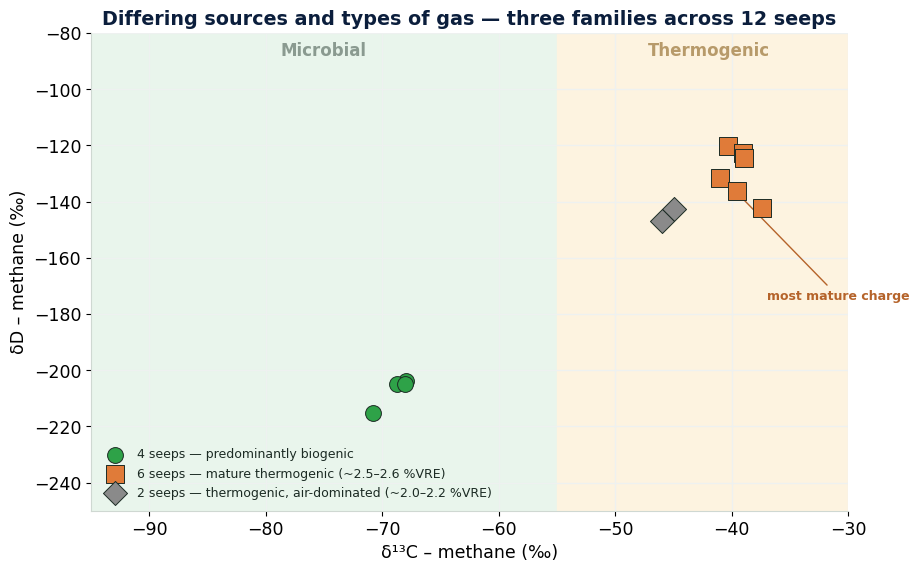
- Differing gas sources and types – the twelve seeps resolve into three families: four of predominantly shallow biogenic gas, six of mature thermogenic gas (~2.5–2.6%VRE), and two of lower-maturity thermogenic gas (~2.0–2.2 %VRE).
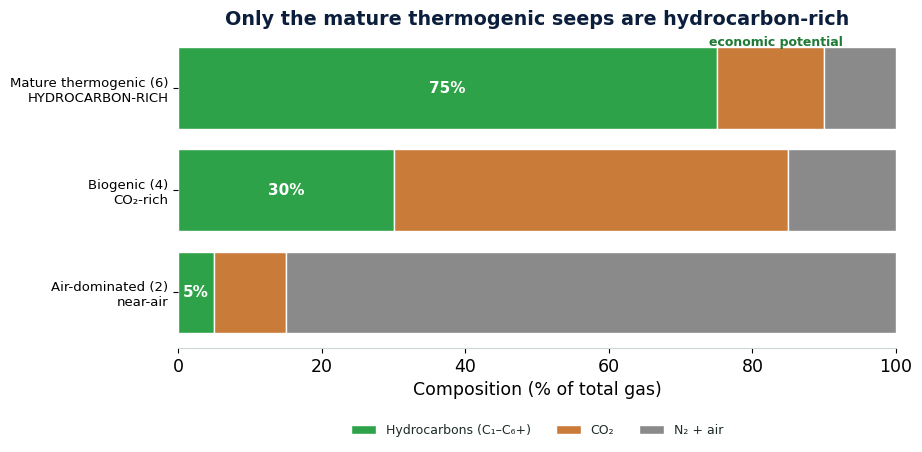
- Non-hydrocarbon gas content – several seeps are dominated by non-hydrocarbon gases: two families carry near-air, inert nitrogen and elevated CO₂ appears in the biogenic seeps – non-hydrocarbon content that dilutes value and would complicate any development.
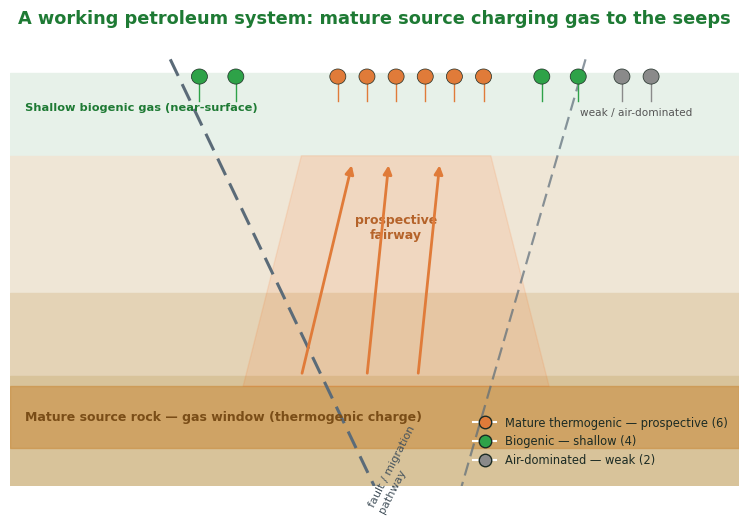
- Resource potential from hydrocarbon content – only the mature thermogenic seep family is hydrocarbon (methane)-rich; these seeps mark what is most likely the most resource-relevant gas and the most prospective part of the basin, while the biogenic and air-dominated seeps carry minimal potential.
- The two lower-maturity thermogenic seeps returned an almost pure air composition –weak or poorly-preserved seepage, flagged as low-confidence and de-prioritised.
Conclusion
By fingerprinting a dozen previously-reported seeps, APT answered the national authority's core question: several sites are charged with mature thermogenic gas, confirming a working petroleum system at depth worth further investigation and exploration. The seeps themselves separated into three families – four of shallow biogenic gas, six of hydrocarbon-rich mature thermogenic gas (~2.5–2.6 %VRE), and two of near-air composition. Only the mature thermogenic seeps are hydrocarbon-rich, marking the resource-relevant gas and the most prospective ground. The study delivered a firm geochemical basis – and a ranked set of leads – from which to develop phase II of the project.