

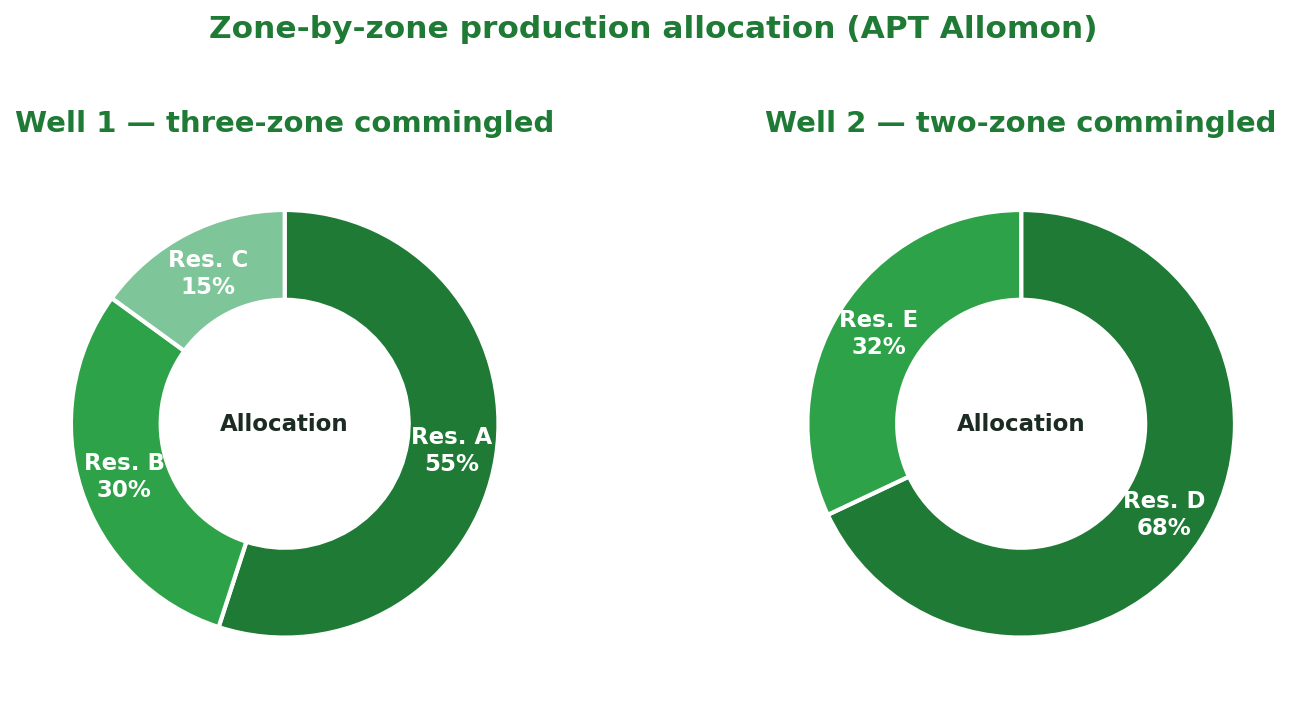
Which zone(s) are my wells really producing from? Across a multi-zone offshore field, the operator needed to understand how commingled production split between stacked reservoirs - without the cost and operational risk of downhole intervention. APT applied its Allomon geochemical fingerprinting workflow to 12 commingled production fluids, allocating each back to its contributing reservoir end members and cross-checking the results against a production logging (PLT) campaign deployed on one of the wells.
Scope Of Work
APT received 12 commingled production-fluid samples drawn from multiple wells across stacked reservoir zones, together with a suite of reservoir "end-member" fluids.
- Focused geochemical fingerprinting of commingled and end-member fluids (SARA, GC-MS)
- Construction of mixing models for each well
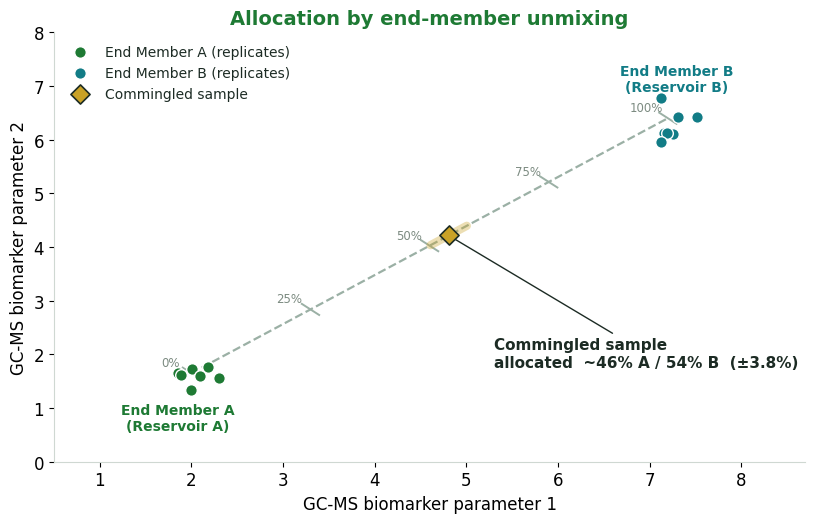
- Deconvolution of each commingled sample using APT's Allomon unmixing toolkit
- Uncertainty analysis via three independent statistical models - Monte Carlo, Bootstrap and Rejection Sampling - each run 10,000 times
- Confidence grading of every allocation solution, QC'd against replicate analyses
“Geochemical allocation lets an operator see howeach zone is really contributing to a commingled stream – at a fraction of thecost of intervention and with no risk to the well. Allomon's tailored approachand robust independent models mean we don't just provide a number; we quantifyhow much to trust it.”
– Craig D. Barrie, Senior Geochemist, APT
Key Highlights
- All 12 commingled samples returned robust allocation solutions, each graded for confidence across three independent statistical models.
- Wells were resolved zone-by-zone - e.g. one well allocated ~55% / 30% / 15% across three reservoirs, another ~68% / 32% across two - built from as many as 500+ geochemical ratios per solution.
- Sampling was timed around the operator's PLT programme (pre-, during- and post-PLT), giving an independent, geochemistry-based cross-check on conventional production logging.
- Uncertainty on the allocation solutions was <5%, comparable to PLT and meter resolution.
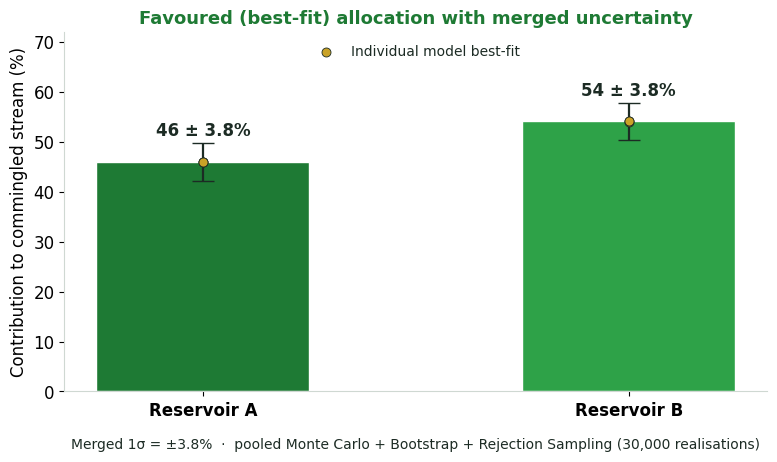
Favoured solution & merged uncertainty. Allomon reports the best-fit (lowest-residual) allocation as the headline answer, corroborated by the median and most-likely solutions. Pooling all three models' 10,000-run ensembles into a single distribution gives one merged uncertainty of ±3.8% (1σ) on the favoured solution - comfortably inside the <5% robust threshold.
Conclusion
By fingerprinting the fluids themselves, APT turned a set of commingled production samples into zone-by-zone allocations the operator could act on - quantifying contributions, grading confidence, and independently corroborating the PLT campaign. Because the method works from routine topside samples, it delivered reservoir-surveillance insight with no additional rig time, personnel or intervention risk. This proof-of-concept allows confidence for expanded and regular future deployment.